
5 Fall Window Display Ideas for Retail Stores in 2026
PRACTICAL FALL VISUAL MERCHANDISING IDEAS FOR A SEASON THAT CAN MOVE FROM LATE SUMMER TO EARLY WINTER
Fall window display ideas need to do more than make a retail store look seasonal. An effective Fall display should help introduce new products, respond to changing weather and guide customers from late-summer shopping into back-to-school, Thanksgiving and early-winter needs.
Fall retail displays can be particularly difficult to plan because the weather does not always follow the calendar. In Canada, the season can stretch from late-summer heat to early-winter cold—sometimes within the same week. Customers may still be shopping for lightweight products while retailers are beginning to introduce knitwear, entertaining essentials and colder-weather merchandise. For this reason, an effective Fall window display should be designed to evolve.
A display might begin with a back-to-school or back-to-routine story, transition into Thanksgiving products and eventually introduce heavier layers or early-winter merchandise. For fashion retailers, layering becomes especially important—not only within the outfits being presented, but in how easily products can be added, removed and restyled as temperatures change. The strongest seasonal window displays provide a clear visual foundation that can carry a retailer through several Fall moments without requiring a complete rebuild every few weeks.
As visual merchandising consultants working with small and mid-sized retailers across Canada and the U.S., we look for display concepts that are both attractive and practical to maintain, easy to shop, and adaptable to changing business needs. Here are five smart considerations when planning your Fall window display, and why they work.
Inspiration image via Pinterest. Original author unknown: https://nz.pinterest.com/pin/247838785739390583/
1. USE TEXTURE TO CREATE AN ELEVATED FALL WINDOW DISPLAY
Why it works
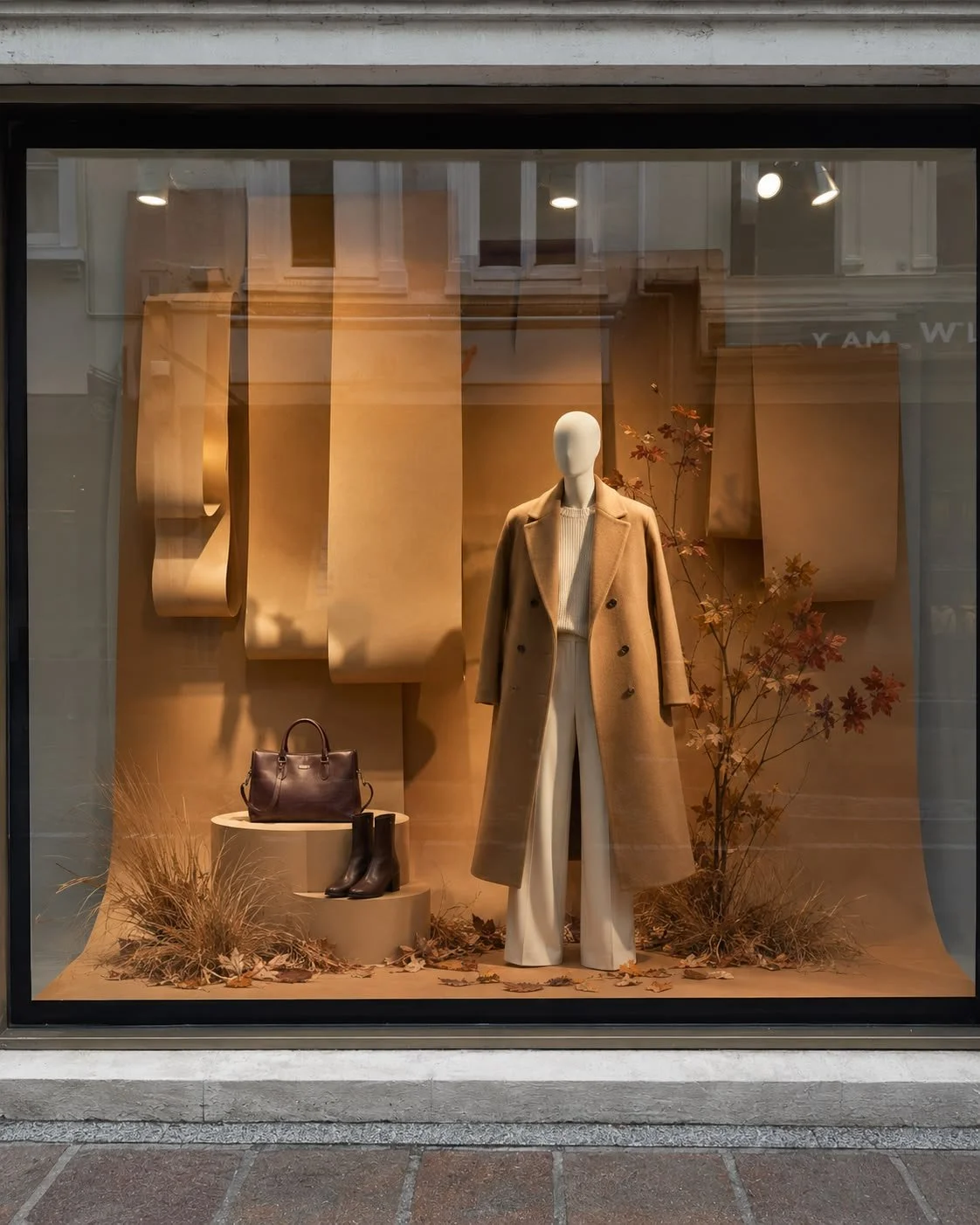
This display creates a clear sense of Fall without depending heavily on pumpkins, plaid or an abundance of artificial leaves.
The oversized paper backdrop introduces warmth, movement and dimension. Because the material has been folded and layered at a dramatic scale, something as simple as kraft-coloured paper begins to feel architectural and elevated.
The dried grasses, scattered leaves and small branch reinforce the seasonal story, but they do not overpower the merchandise. The mannequin remains the focal point, supported by a coordinated handbag and footwear presentation.
The neutral backdrop also gives the retailer flexibility. The camel coat could be replaced with a lighter jacket during a warm September, then updated with knitwear, scarves and heavier outerwear as temperatures drop, all without changing the main installation.
For mid-sized retailers with multiple locations, a concept like this could also be reproduced through pre-cut paper panels, fabric treatments or repeatable modular backdrops.
Takeaway
Build the seasonal atmosphere into the backdrop, then allow the products to change with the weather.
Paper, fabric, unfinished wood, woven materials and textured panels can communicate warmth without locking a display into one specific holiday. A strong neutral foundation can move from late summer into early winter through changes to the merchandise, styling and product layers.
For fashion retailers, treat layering as part of the visual merchandising strategy. Begin with lighter transitional pieces, then gradually introduce sweaters, scarves, boots and outerwear as the season progresses.
Credit: Natalia Tibavisco Florez (https://co.pinterest.com/pin/420453315218572066/)
2. TRY AN UNEXPECTED FALL COLOUR PALETTE
Why it works
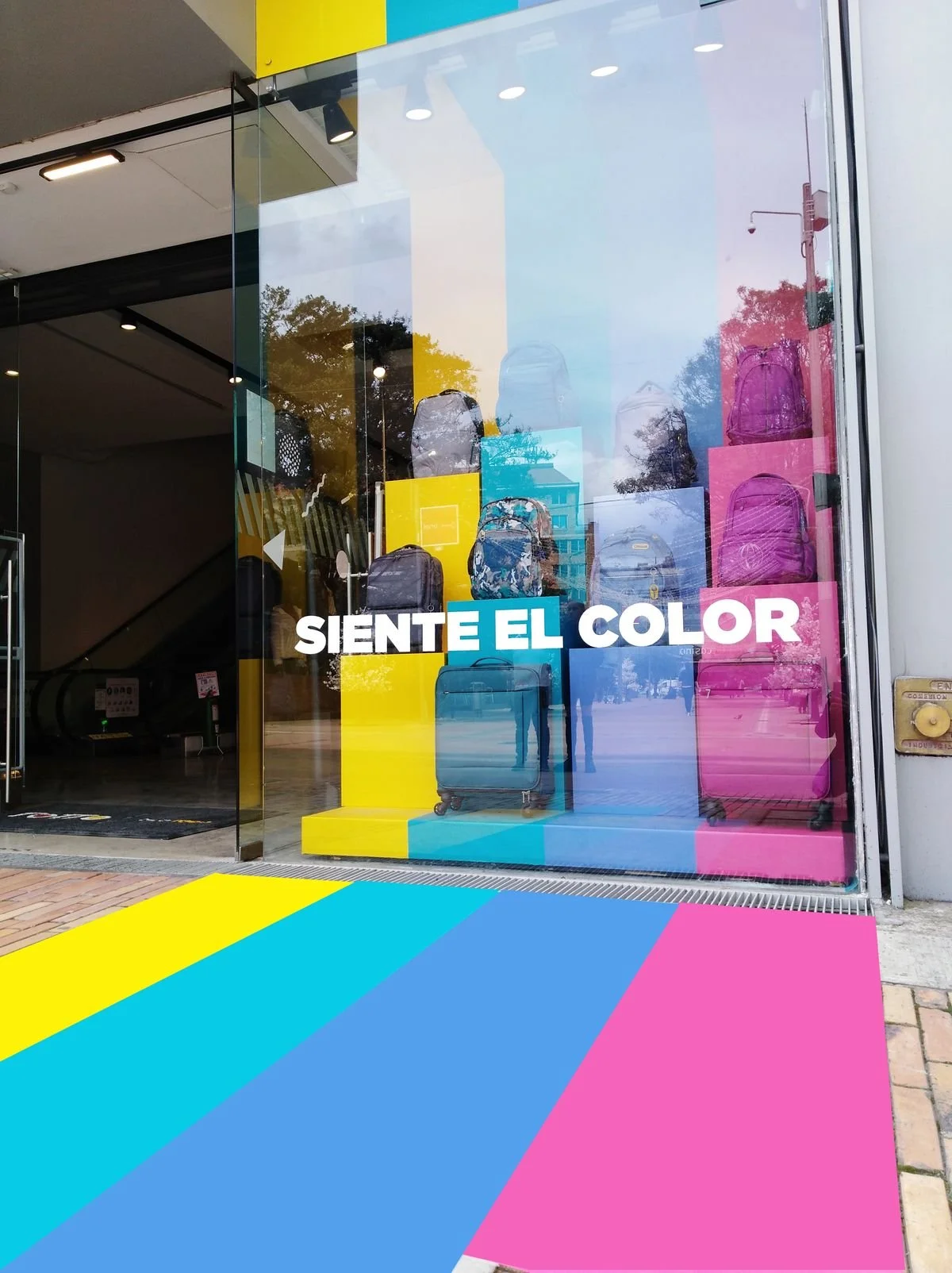
Fall retail displays do not always need to rely on brown, rust, orange and burgundy. In fact, because we can anticipate many retail storefronts to follow the typical Fall colour palette, going against the norm would mean helping your store stand out.
This window uses distinct blocks of yellow, turquoise, blue and pink to organize the merchandise and command attention from a distance. The colour treatment continues across the backdrops, platforms and ground-level elements, making the entire display feel deliberate and connected. The window could support a back-to-school, back-to-work or Fall-travel campaign despite having no obvious autumn props.
Most importantly, the colour does not compete with the merchandise. It helps divide the window into clear product stories while the repeated format creates consistency across the full display.
For a mid-sized retailer, this colour-blocking approach could be adapted across several locations using vinyl, painted panels, paper rolls or reusable platforms.
Takeaway
Begin with the merchandise and the brand—not with a predetermined idea of what Fall is supposed to look like. Pull two or three colours from the current product assortment and repeat them through backdrops, risers, signage or display fixtures. An unexpected colour palette can help a seasonal window feel fresh and distinctive while remaining relevant to the products being sold.
Original source unknown. https://kr.pinterest.com/pin/458804280809201790/
3. DESIGN A FALL RETAIL DISPLAY THAT CAN EVOLVE
Why it works
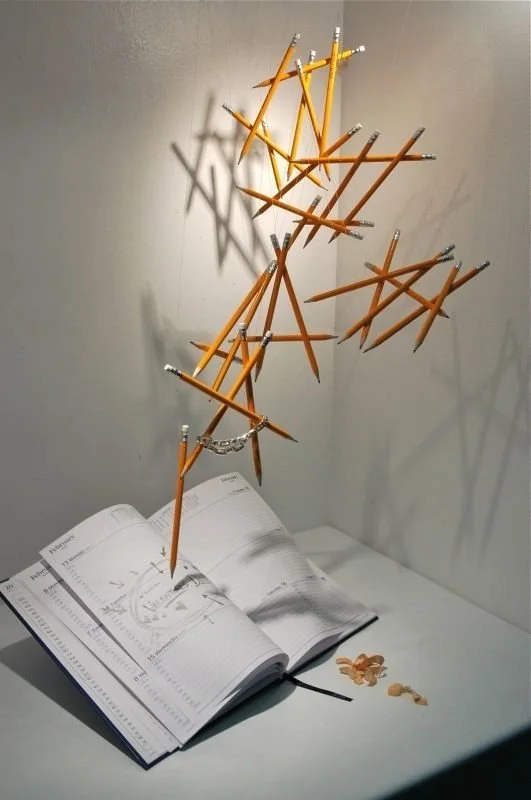
This display takes a familiar back-to-school object, like the pencil, and transforms it into a sculptural installation. Rather than building a literal classroom scene, the suspended pencils create movement, surprise and an immediate seasonal reference. The concept communicates back-to-school or back-to-routine in a way that feels more creative and memorable.
It also illustrates one of the most important considerations when planning a Fall retail display: Fall is not one retail moment. It is a sequence of retail moments. A Fall display may begin with school supplies, organization, travel, transitional clothing or a return to routine. As September moves into October, the same space may need to feature Thanksgiving entertaining, harvest products, Halloween or cooler-weather essentials.
The most practical approach is to establish a flexible visual structure and update the merchandise, messaging or smaller supporting elements as the season changes. For fashion retailers, this may mean keeping the same backdrop while changing the outfit layers. A lightweight top can become a cardigan look, then a jacket story and eventually an outerwear presentation.
Takeaway
Plan Fall as a series of chapters rather than one installation that remains unchanged from August through November. A display could move from late-summer transition into back-to-school, early Fall, Thanksgiving and eventually early winter. The framework can remain consistent while the merchandise and messaging evolve.
This helps the store stay current without requiring the team to rebuild the entire display every few weeks.
4. USE REPETITION TO CREATE HIGH-IMPACT SEASONAL MERCHANDISING
Why it works
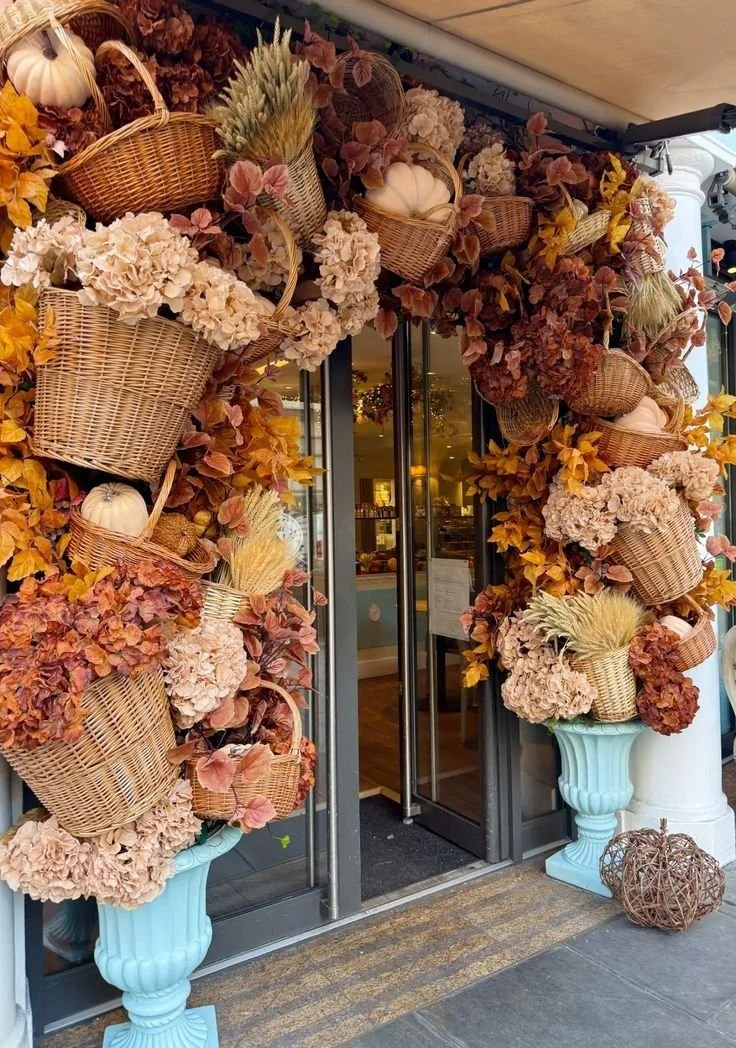
This entrance is extremely full, but it still reads as one coordinated seasonal story. The installation repeats a limited group of materials: woven baskets, hydrangeas, foliage, wheat and pale pumpkins. Although there are many individual elements, the controlled palette and repeated forms make the overall presentation feel unified. The abundance also frames the doorway and draws attention toward the entrance, even from a distance.
A mid-sized retailer may not need - nor have the labour, budget or storage capacity—to reproduce an installation of this scale. However, the principle can be adapted to a smaller window, launch zone, cash area or store entrance. The idea is to select a small visual vocabulary and repeat it with intention.
Takeaway
When creating a fuller Fall display, limit the number of materials, colours and shapes. Instead of combining pumpkins, signs, leaves, hay bales, lanterns, crates and every other available Fall prop, choose two or three key elements and repeat them at different heights or scales. A retailer might repeat one style of basket, one type of foliage and a tonal family of cream, rust and brown. The same principle can be applied to merchandise by repeating one product category in generous quantities. Repetition creates impact. Too many unrelated ideas create visual noise.
Credit: The Decor District, www.thedecordistrict.com
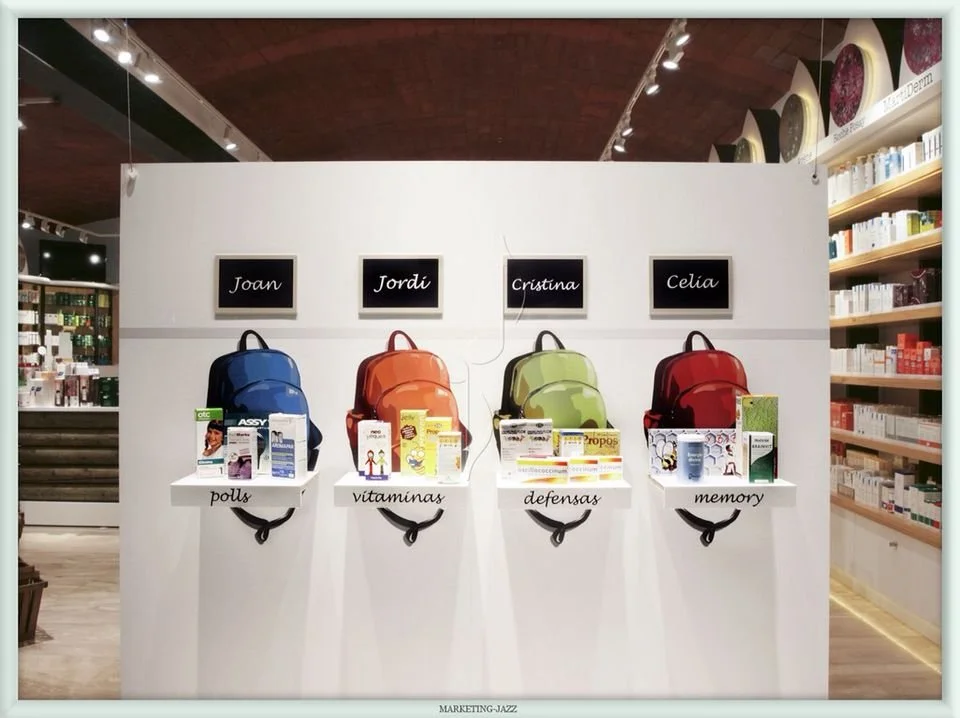
Credit: Marketing-Jazz for Farmacia Santa Maria, “La Vuelta al Cole. https://es.pinterest.com/pin/556968678933750712/
5. MERCHANDISE COMPLETE CUSTOMER SOLUTIONS—NOT JUST PRODUCTS
Why it works
This display does more than present four backpacks. It curates product groupings around a different customer profile or need. The bags are visually separated, labelled and paired with complementary merchandise. This helps customers understand who each collection is intended for, how the items work together and what else they may need. That strategy is especially useful during transitional seasons because customers may be shopping for very different circumstances at the same time. One person may need back-to-school products. Another may be returning to the office. Someone else may be preparing for Thanksgiving travel, wet weather or colder mornings. By presenting products as complete solutions, the display turns a broad assortment into clear and understandable shopping stories.
Takeaway
Do not simply group similar products together. Show customers how they can use them. Build displays around questions such as:
Who is this for?
What need does it address?
What should be worn or used with it?
What might the customer need next?
How can the product transition as the season changes?
For fashion retailers, this could mean presenting one outfit with several possible layers: a lightweight base, a cardigan, a jacket and an outerwear option. For home, wellness and lifestyle retailers, it could mean creating product groupings around back-to-routine, Thanksgiving hosting, weekend travel or preparing for colder weather. The easier it is for customers to understand the complete solution, the easier the display becomes to shop, and the greater the opportunity for complementary purchases.
***See more about lifestyle vs. commodity style merchandising here.***
FINAL THOUGHTS
The most effective seasonal retail displays are built with flexibility in mind. They establish a clear Fall atmosphere while allowing products, layers and messages to be updated as customer needs change. Rather than designing one static Fall installation, consider how the presentation can move from late summer to back-to-school, early Fall, Thanksgiving and eventually early winter. Use adaptable backdrops. Create interest through texture and colour. Repeat a limited number of visual elements. Organize products around real customer needs. Most importantly, make sure the merchandise can change without weakening the overall display. Fall may be inconsistent, but your retail presentation does not have to be.
VM ID Inc. provides visual merchandising services for small, mid-sized and national retailers across Canada and the U.S. Our team supports seasonal window display planning, retail display strategy, store refreshes, product merchandising and hands-on implementation.
Additional Readings:
Have a window, launch zone or retail display that needs a stronger seasonal plan? Book a visual merchandising consultation with VM ID Inc.